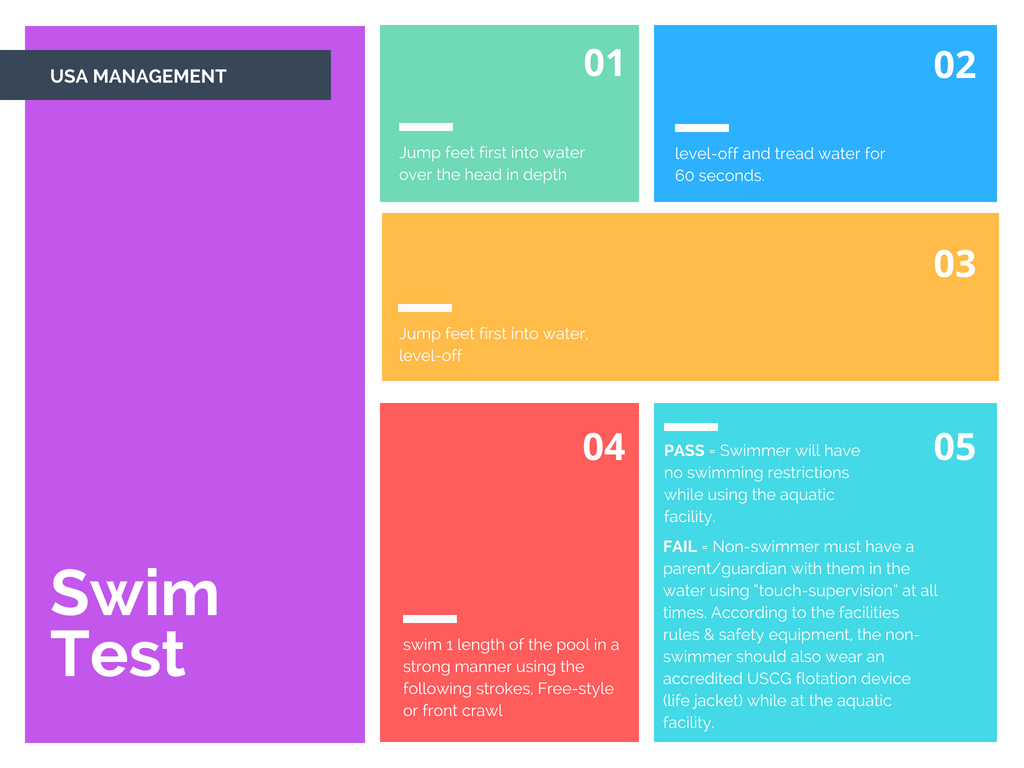

SWIM TEST PROTOCOL
The swim test of individuals participating at an aquatic facility is a key element in both aquatic safety and basic water safety standards. Swim tests should be performed annually to children under the age of 14 years old or 48 inches or less. A swim test is developed to demonstrate a skill level consistent with the circumstances in which a participant will be in the water without a parent or guardian at their side using “touch-supervision” or using proper USCG flotation device (life jacket). A swim test will demonstrate the minimum level of swimming ability for recreation activity in a confined body of water. “Touch-supervision” means that the supervising adult is constantly monitoring the swimmer and within immediate (arm’s length) reach of the swimmer. Watch Around Water is an organization that USA Management is proud to have partnered with to help promote water safety awareness to reduce drownings or near drownings. A Swim Test is another practice to help promote water safety in and around water.
A lifeguard will administer the swim test. Swim tests will be given upon child’s arrival to facility or during safety breaks throughout the day at the lifeguards’ discretion. After the test is given, the lifeguard will record the result from the given test into a database. All staff at the aquatic facility will have access to this information.
PURPOSE OF POLICY:
USA Management has adopted the Swim Test Protocol to promote water safety at all aquatic facilities. The swim test program has five basic objectives.

To promote water safety
and reduce drownings and near drownings at aquatic facilities.

To conduct a safe aquatic facility program.

To promote and encourage learn to swim classes for self-preservation in children.

To identify swimmers and non-swimmers at an aquatic facility.
To promote aquatics recreation.
Yes, a child can usually retake the test after more practice, and the facility can tell you when and how. Until they pass, they need a life jacket or an adult within arm’s reach. Swim lessons are the fastest way to build the skills needed.
Swimming skills change with growth, and they fade when a child has not been in the water for months. A yearly test gives guards a current picture of each child’s ability, not last summer’s.
No, the protocol is applied the same way to every child in the age and height group, whatever their experience. This keeps the rule fair and lets the guards see each child’s ability for themselves.
- All children under 14 years old
- Children 14 or older who are 48 inches tall or less
- Children 14 or older and taller than 48 inches are outside the protocol
- Practice swimming a full length without stopping
- Practice treading water and floating calmly
- Explain that the test is a safety step, not a competition
- Bring them rested, so they are not tired from a long day
- The lifeguard records it in the facility’s database
- All staff on duty can see it
- Guards use it to know who needs a life jacket or arm’s-length supervision
- The protocol is designed for children under 14 or 48 inches
- Adults who cannot swim well should stay in shallow water
- A life jacket is a good idea in deeper areas
- Ask a lifeguard if you are unsure about the depth
- Choose trained lifeguards to give the test
- Set up a marked test area with clear depth
- Record results and share them with all staff
- Tell parents about the test before the season starts
No, Passing shows the minimum ability for recreation in a confined body of water, nothing more. Facility age rules still apply, and younger children still need an adult, since even good swimmers can panic, tire, or get into trouble.
Knowing how many non-swimmers are in the pool on a given day shows where guards should stand and how many are needed. On busy days, a high number of non-swimmers is a sign to add coverage or limit access to deep areas.